Desktop vs Mobile CPM — device choice changes the money math more than most beginners realize. In Tier-1 GEOs (US/UK/DE), desktop and mobile don’t just differ in CPM—they differ in intent density, session length, ad viewability, and the placements that send those clicks. This guide gives you a practical answer first, then shows how to use live data and a 7-day plan to prove it with your own links.
Need live numbers while you read? Open Payout Rates in a new tab and keep it handy.
Short answer
- Desktop usually delivers a higher CPM per 1,000 impressions in Tier-1 because ad slots are larger, dwell time is longer, and completion/viewability tend to be stronger. Desktop also favors “how-to” and tool workflows (research, downloading, docs, spreadsheets), which often click through with clearer intent.
- Mobile usually wins on volume and speed—more sessions, easier to spark micro-actions from social feeds, and a broader top of funnel. CPM per 1,000 can be lower than desktop, but the total payout can still be bigger if you place correctly (first line of a pin, top lines of a video description, etc.).
Your goal isn’t device bragging rights—it’s net earnings. Use device-aware angles to match intent, then follow a tight test plan (below) to confirm where your EPC is highest for US/UK/DE.
Desktop vs Mobile CPM: Benchmarks
We keep a single source of truth for live Desktop vs Mobile CPM benchmarks on our Payout Rates page with country and device splits. The right way to read it:
- Scan per-device CPM for US/UK/DE. Use it as a prior, not a prophecy.
- Segment your analytics by device to compare your EPC against those priors.
- If your EPC is diverging from the priors, it’s almost always about placement and promise (anchor text) rather than the country mix itself.
→ Check the live device/Country table here once per week: Payout Rates (open in new tab)
How to interpret fast – Desktop vs Mobile CPM:
- If desktop CPM is higher than mobile for your Tier-1 mix, you can afford fewer but stronger desktop placements (e.g., tutorial posts, GitHub gists, Notion docs, Medium “how-to”) and still outperform a flood of mobile clicks.
- If mobile CPM closes the gap (or briefly exceeds desktop in a country), prioritize top-line placements in mobile-first feeds (Pinterest, YouTube descriptions, X/Threads bios, Reddit mobile comments) and keep titles benefit-first and short.
Desktop vs Mobile CPM: Posting angles (device-aware)
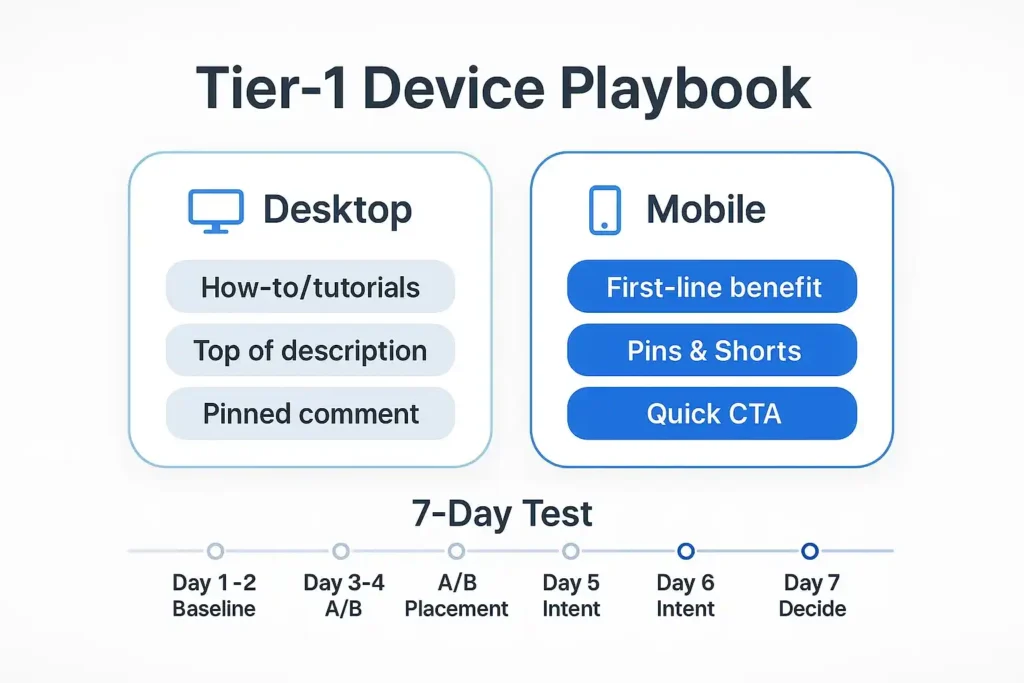
Desktop angles (US/UK/DE)
Where desktop shines: research tasks, tools, downloads, longer guides, spreadsheets, “work mode.”
High-yield placements
- YouTube long-form: put the short link in the first two lines (visible without expanding) and add a pinned comment for redundancy.
- Medium/Blog/Docs: step-by-step tutorials with the first CTA above the fold, a second mid-post, and a final CTA at the end (don’t over-link; keep it clean).
- Reddit how-to answers: in subs where users solve problems from a laptop (devtools, productivity, research tools).
Anchor ideas
- “Download the 2025 Starter Template (free)”
- “Open the official tool (no signup)”
- “Try the clean URL shortener (fast redirects)”
Creative notes
- Desktop readers tolerate one clean screenshot or a small diagram. Keep file size light and captions helpful (don’t repeat the H2).
Mobile angles (US/UK/DE)
Where mobile shines: snackable “quick win,” checklists, free resources, coupons, templates, and video-driven discovery.
High-yield placements
- Pinterest pins: first line of description with a direct benefit.
- YouTube Shorts: the first two lines of the description matter even more on mobile; repeat with a pinned comment.
- Reddit mobile threads: short, helpful one-liner + link; post early while threads are fresh.
Anchor ideas
- “Download template (free, 1 click)”
- “Open the tool (mobile-friendly)”
- “Quick guide — 2 minutes”
Creative notes
- Prefer shorter titles (4–7 words) and emojis only if natural (don’t force them). Ensure the first 70–90 characters of your description carry the benefit.
Desktop vs Mobile CPM: 7-day plan (prove it with your own data)
Goal: confirm where EPC is higher for your Tier-1 mix—desktop or mobile—and which placements win within each device.
Setup (once)
- Use the UTM scheme from your Tracking 101 guide (source/medium/campaign/content).
- Campaign for this test:
device-benchmarks-tier1. - Content labels:
desktop-title-a,desktop-title-b,mobile-title-a,mobile-title-b.
Daily cadence (≈20 minutes)
Day 1–2 — Baseline
- Publish 4 placements:
- Desktop-leaning: 1 YouTube long-form (description top lines), 1 Medium/blog post.
- Mobile-leaning: 1 Pinterest pin, 1 YouTube Short (desc + pinned).
- Keep anchors parallel (same promise) so you don’t bias the test.
Day 3–4 — Micro A/B
- Duplicate the placements with title/anchor variants:
…title-avs…title-b(only change the benefit line, not the destination).
- Add one Reddit helpful answer each day (one desktop-leaning sub, one mobile-heavy sub).
Day 5 — Placement height
- On YouTube, move the link higher in the description (line 1).
- On Pinterest, tighten the first line (put the benefit word first).
- Log changes with UTM
…line-1vs…line-2.
Day 6 — Intent booster
- For desktop posts, add a tiny “what it solves” sentence right above the link.
- For mobile pins, add “(free)” or “(no signup)” if true; remove fluff words.
Day 7 — Decide & scale
- Open your stats and segment by device and source/medium.
- Compute EPC per slice. Choose your winners for the next 14 days.
What “winning” looks like (Desktop vs Mobile CPM)
- Desktop EPC beats mobile: concentrate on long-form/tutorial angles, keep a steady trickle of mobile for volume.
- Mobile EPC beats desktop: double down on pins + shorts with ruthless first-line benefit clarity.
If you’re unsure how to pace withdrawals while testing device mixes, skim this comparison next: Daily vs Weekly Payouts — Which Makes You More Money?
Practical patterns Desktop vs Mobile CPM (Tier-1 specifics)
- US: mobile volume is massive; desktop research still pays. A mixed plan wins—shorts/pins for discovery, long-form for monetization.
- UK: tighter windows of activity; desktop evenings perform nicely for tutorials.
- DE: straightforward anchors outperform hype. If EPC lags on mobile, check your placement height and remove vague verbs.
Desktop vs Mobile CPM: Placement performance
- Put the link where the click happens naturally (top description lines, first line of a pin, first sentence of a helpful answer).
- Match the promise to the destination—don’t promise “direct download” if the page is a guide.
- One clean link is better than a cluster. If you must add a second, list them as bullets.
For official guidance on optimizing by device (and why Desktop vs Mobile CPM can diverge), see Google’s Help page on device targeting.
Desktop vs Mobile CPM: Reading data (fast)
Focus on EPC first, CTR second. Device splits can fool you:
- High mobile clicks, low EPC → your promise is attractive but the destination context isn’t mobile-friendly, or the first fold slows them.
- Fewer desktop clicks, strong EPC → keep desktop tutorials alive; a few quality clicks can out-earn a thousand casual ones.
Cross-check your device mix with Payout Rates once a week. If live CPM suggests desktop > mobile in a GEO but your EPC shows the opposite, fix placement height or anchor clarity before you blame the table.
FAQ
Does desktop always pay more?
No. It often has higher CPM in Tier-1, but your EPC can flip if your mobile placements are superior (first-line benefits, stronger thumbnails, better timing).
What if my mobile traffic wins EPC but the table shows desktop higher CPM?
Placement beats priors. Keep what works; your anchors and where you place links are the levers that matter most.
How long should I run the device test?
One week is enough to spot direction. Keep iterating for two more weeks to lock the pattern.
Should I split sittings across time zones?
Yes. Post during each country’s peak hours (evening local time usually works). Segment by country if possible.
Where are the rules and thresholds?
All payout/threshold basics live in our FAQ. Read it once—it prevents 90% of beginner mistakes.